

The Jerk
Why worry about the worst players?

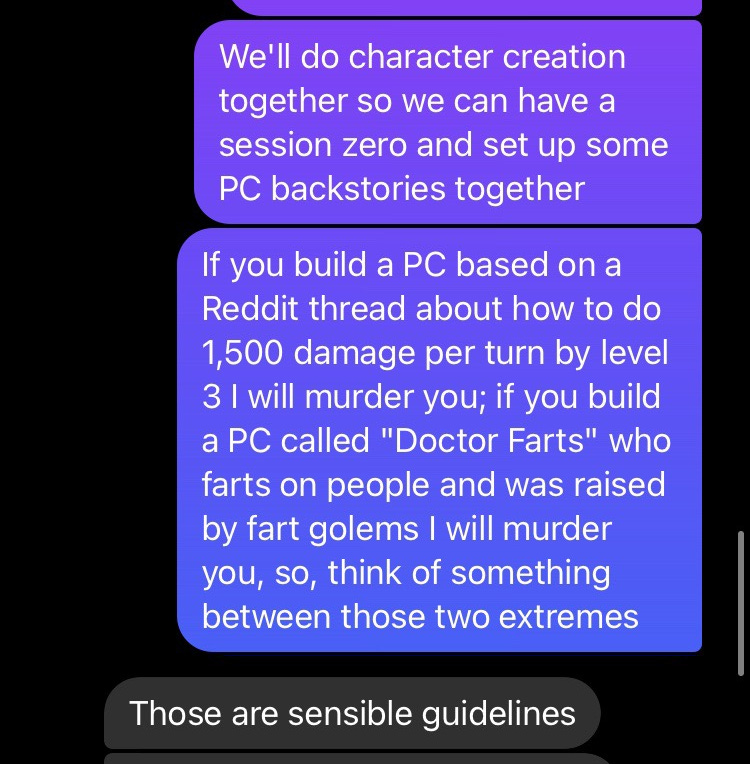
Something that gets brought up in game design is the worry of “That Player”, the one who uses their awesome powers of number crunching and weaponised neurodivergence to create characters and situations that completely break the game, even with rules-light systems. Or players that will always take one good look at a dungeon or puzzle and immediately want to blow past all of it to get to the end.
There are agonising discussions like the following of how to balance the rules to counteract or nullify these kinds of players, as the TTRPG space becomes a sort of arms race between power scalers, and designers not wanting their games to be manipulated away from the GMs who buy our books.
But frankly, this is all bullshit; nobody should be bending their rules and wasting their time thinking about these kinds of players because, frankly, most people do not play like this.
From my experience, there are some pretty overpowered spells and moves you can do in Black Powder and Brimstone, but I don’t see a lot of people flocking to those spells or feats because they are not thematically attractive to everyone. When people enter a game with a specific theme, they have a character in mind already that they want to play, regardless of what the “correct” character choice is to be the most efficient at playing what is basically an improv set with dice.
So why do these players do this? My theory is that it’s what happens when a game is presented and run like a game of spreadsheet management, coupled with how long it takes to create a character.
If you, as a GM, are super stringent with the rules, then players won’t want to break out of them and be creative. If the system is all that can be played, then players will want to game the system to get an advantage.
Secondly, if your character takes a long time to set up and put together, you as a player will want to protect that time investment in any way you can.
Now these can be amended with a looser play style, and using a system where you can make a character in minutes or seconds, thus you see the rise of more rules-light games that are presented more as a collaborative story exercise than a game of winners and losers.
Ultimately, it comes down to trust: the GM should trust the players not to undermine their game, and the players should trust the GM not to shoot down every cool thing they want to do.
This is personally why I don’t really care too much about rules balancing in my games, so long as there isn’t anything super crazy that either breaks the game or makes it grinding or un-fun to play, I’m not going to lose sleep over hypothetical players abusing the rules to kill the final boss in two hits. Yes, they exist, but they are not the majority.